Showing posts with label technique. Show all posts

Saturday, February 11, 2012

Discovering the Basics


I'm Baaaaack. After a Year-long hiatus, a 500 mile move, and a complete-life change, I'm back to parlaying my loosely defined, fully amateur, kitchen wisdom (if you can call it that). I have a lot of back-writing to do, so stay tuned. My kitchen is smaller, the dishes are getting increasingly more complex (more delicious too) and I am dead-focused on bettering my techniques. 

At times I think my life is a lesson in circumventing the lessons that basic things have to offer. I have a long history of diving, feet first, into things and swimming around until I have a "jack-of-all-trades" understanding of these things. Though often a hard lesson to learn, harnessing the power of the basics can be instrumental in discovering the subtle differences between an amateur and a master.

Thus is the case with stocks. Often a basic ingredient in many a repetoire, a stock serves as the foundation of a great dish. In french they are referred to as "fonds du cuisine" or, loosely translated, the foundation of the kitchen. Julia Child takes this a step further calling them the "working capital of the kitchen" and hence the term "stock".What I [now]  find sad is that all too many times I and many others I know are comfortable using a purchased, off the shelf stock to prepare my meals. After this last week, however, this is far more likely to be the exception rather than the rule.

Why? Because last week, I discovered the power of veal stock.

Veal stock is the ultimate argument for tedium in the kitchen. Sure it's easier to pop the top off a box of culinary stock from a store, but when tasted side-by-side with a dish made with fresh, delicious, homemade stock, the comparison is night and day. Thus was the case with a chicken marsala that was, quite simply, amazing.

Making stock is not glamorous, it isn't quick, it isn't easy, and it's damn hard to come across the ingredients in today's "everything is pre-prepped" world. Being completely unfamiliar with my new surroundings, finding veal bones adequate for making stock was harder than I was prepared for. However, after a few calls, I managed to get hold of about 8 lbs of bones and I took to making Michael Ruhlmans basic recipe for a classic veal stock.

Now, Unfortunately, this recipe is not mine... and is copyrighted... and so you won't be seeing it unless you pick up a copy of Ruhlmans book The Elements of Cooking (which would be a worthwhile purchase to begin with). But any basic stock recipe will do just be sure to substitute with veal bones as the natural collagen in these bones is what makes for an amazing tool of the kitchen.

This week's discipline: Preparedness

How do you teach a grown adult male who is the general equivalent of a twelve year old boy with a crippling case of ADHD and zero organizational skills to be prepared? Start with the basics, make it fun, and throw in a couple of fancy foreign terms. I started the stock by setting my "mise en place" which is just a fancy way of saying: "take every thing you need to do what you're about to do, and put it in one place in an organized fashion." This way you aren't making 100 trips to the cabinet or searching for your tools. To some people this is simple logic... to me, it's a revelation.
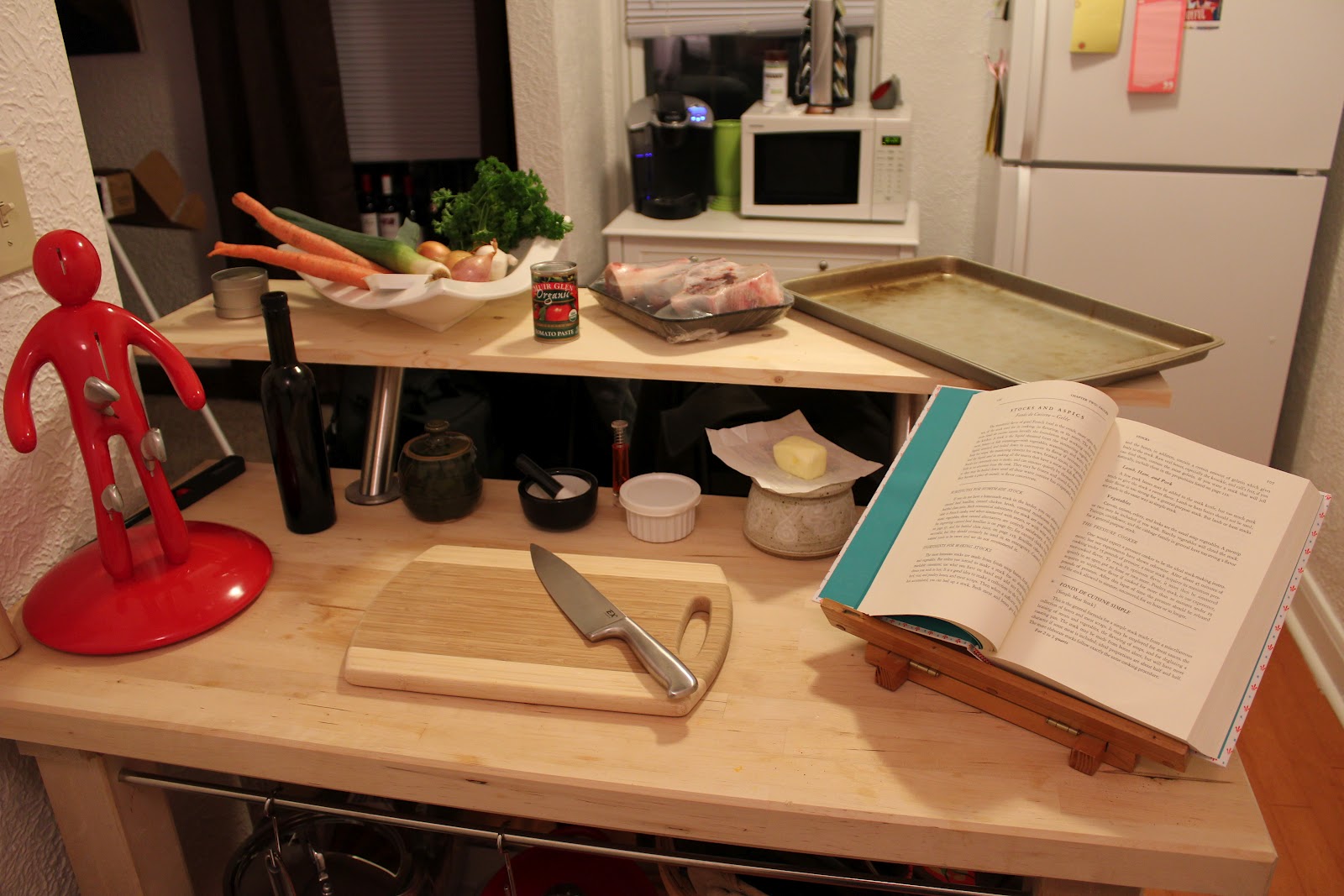
Next was the prep: Roasting the bones.
Then Came the simmering and skimming of the scum


Then the aromatics:


Then, nearly 10 hours later... The finished product:


It truly has been a labor of love, but every dish I've made thus far has been a complete change. Trust me when I say that it was long, tedious, at times required more focus than I could give, but it has made a significant impact on the way I view food preparation. It is recommended that you use up your stock within 2-3 days of making it. One taste, and I guarantee it won't even last that long. Hello Wisconsin!

Friday, June 5, 2009

Much Ado About Mushroom

So I think the general format here is going to revolve around Brett primarily posting recipes and anecdotes, and me maybe highlighting one of the ingredients he used in the recipe. Be on the lookout for my cooking philosophies as well. It’s a fluid format for now, so work with us and allow room for future changes.

Ownership of cooking is an important concept to me. Take recipes you see here, omit some things, add others. Double the onions, halve the peppers. Create food you and your friends and family want to eat. Look at Brett’s first recipe, he talks about “a bit” of this and “some” of that. If you’re putting chopped tomatoes in a measuring vessel to make sure you have exactly ½ cup, you’ve missed the point and the fun. Naturally, I’m talking about non-structural elements here, if we post a cake recipe, you can’t arbitrarily use less flour.

How do you accomplish this style of cooking? Through tasting. Taste the ingredients, taste your sauces, taste your finished product. Never let anything go out of your kitchen without a final taste.

Portabella Mushrooms

Brett’s first recipe hit upon one of my favorite ingredients. Mushrooms truly are the love’em or hate’em ingredient. So why am I highlighting such a controversial ingredient? Simply, mushrooms get a bad rap, meld well with a variety of flavors and at least deserve a second chance among anyone that thinks they don't like them. I suspect many of the mushroom haters were chagrined as children when their parents denied them the privilege of pepperoni on pizza and were served canned white mushrooms instead. Cook mushrooms from fresh, and I'm sure you'll find a much more agreeable flavor and texture.

On the other side of the coin, those of us that admire the fungi simply can’t get enough. For us, it’s a lucky thing that mushrooms have so many different applications. They can improve a salad or a steak, get sautéed with chicken or stuffed with crab, or even become the stuffing themselves. All these applications and I haven’t even mentioned the psychoactive properties of some varieties.

The Portabella is, of course, the steak of mushrooms. It’s large, meaty and simply delicious. As such, I love leaving Portabellas whole letting their texture shine through. Do this: Marinate some whole portabellas for a few hours in a mixture of balsamic vinegar, olive oil and black pepper. When they’ve marinated, throw them on the grill, season to taste and cook until done. When are they done? When they are cooked to a texture you like. I’m sorry, that’s the answer. Eat the mushroom just like that. Not looking forward to a big mushroom for dinner? Grill some olive oil brushed ciabatta along side your mushrooms and make a sandwich with goat cheese and baby spinach leaves. Don’t like goat cheese? Use feta. Don’t like feta? Use blue. Don’t like any of those? Stop pretending you like cheese.

Go out, buy some mushrooms and experiment with them. They’ve got myriad applications and are guaranteed to help you feed your friends, satiate your neighbors and expand your cooking horizons.