Showing posts with label julia child. Show all posts

Saturday, February 11, 2012

Discovering the Basics


I'm Baaaaack. After a Year-long hiatus, a 500 mile move, and a complete-life change, I'm back to parlaying my loosely defined, fully amateur, kitchen wisdom (if you can call it that). I have a lot of back-writing to do, so stay tuned. My kitchen is smaller, the dishes are getting increasingly more complex (more delicious too) and I am dead-focused on bettering my techniques. 

At times I think my life is a lesson in circumventing the lessons that basic things have to offer. I have a long history of diving, feet first, into things and swimming around until I have a "jack-of-all-trades" understanding of these things. Though often a hard lesson to learn, harnessing the power of the basics can be instrumental in discovering the subtle differences between an amateur and a master.

Thus is the case with stocks. Often a basic ingredient in many a repetoire, a stock serves as the foundation of a great dish. In french they are referred to as "fonds du cuisine" or, loosely translated, the foundation of the kitchen. Julia Child takes this a step further calling them the "working capital of the kitchen" and hence the term "stock".What I [now]  find sad is that all too many times I and many others I know are comfortable using a purchased, off the shelf stock to prepare my meals. After this last week, however, this is far more likely to be the exception rather than the rule.

Why? Because last week, I discovered the power of veal stock.

Veal stock is the ultimate argument for tedium in the kitchen. Sure it's easier to pop the top off a box of culinary stock from a store, but when tasted side-by-side with a dish made with fresh, delicious, homemade stock, the comparison is night and day. Thus was the case with a chicken marsala that was, quite simply, amazing.

Making stock is not glamorous, it isn't quick, it isn't easy, and it's damn hard to come across the ingredients in today's "everything is pre-prepped" world. Being completely unfamiliar with my new surroundings, finding veal bones adequate for making stock was harder than I was prepared for. However, after a few calls, I managed to get hold of about 8 lbs of bones and I took to making Michael Ruhlmans basic recipe for a classic veal stock.

Now, Unfortunately, this recipe is not mine... and is copyrighted... and so you won't be seeing it unless you pick up a copy of Ruhlmans book The Elements of Cooking (which would be a worthwhile purchase to begin with). But any basic stock recipe will do just be sure to substitute with veal bones as the natural collagen in these bones is what makes for an amazing tool of the kitchen.

This week's discipline: Preparedness

How do you teach a grown adult male who is the general equivalent of a twelve year old boy with a crippling case of ADHD and zero organizational skills to be prepared? Start with the basics, make it fun, and throw in a couple of fancy foreign terms. I started the stock by setting my "mise en place" which is just a fancy way of saying: "take every thing you need to do what you're about to do, and put it in one place in an organized fashion." This way you aren't making 100 trips to the cabinet or searching for your tools. To some people this is simple logic... to me, it's a revelation.
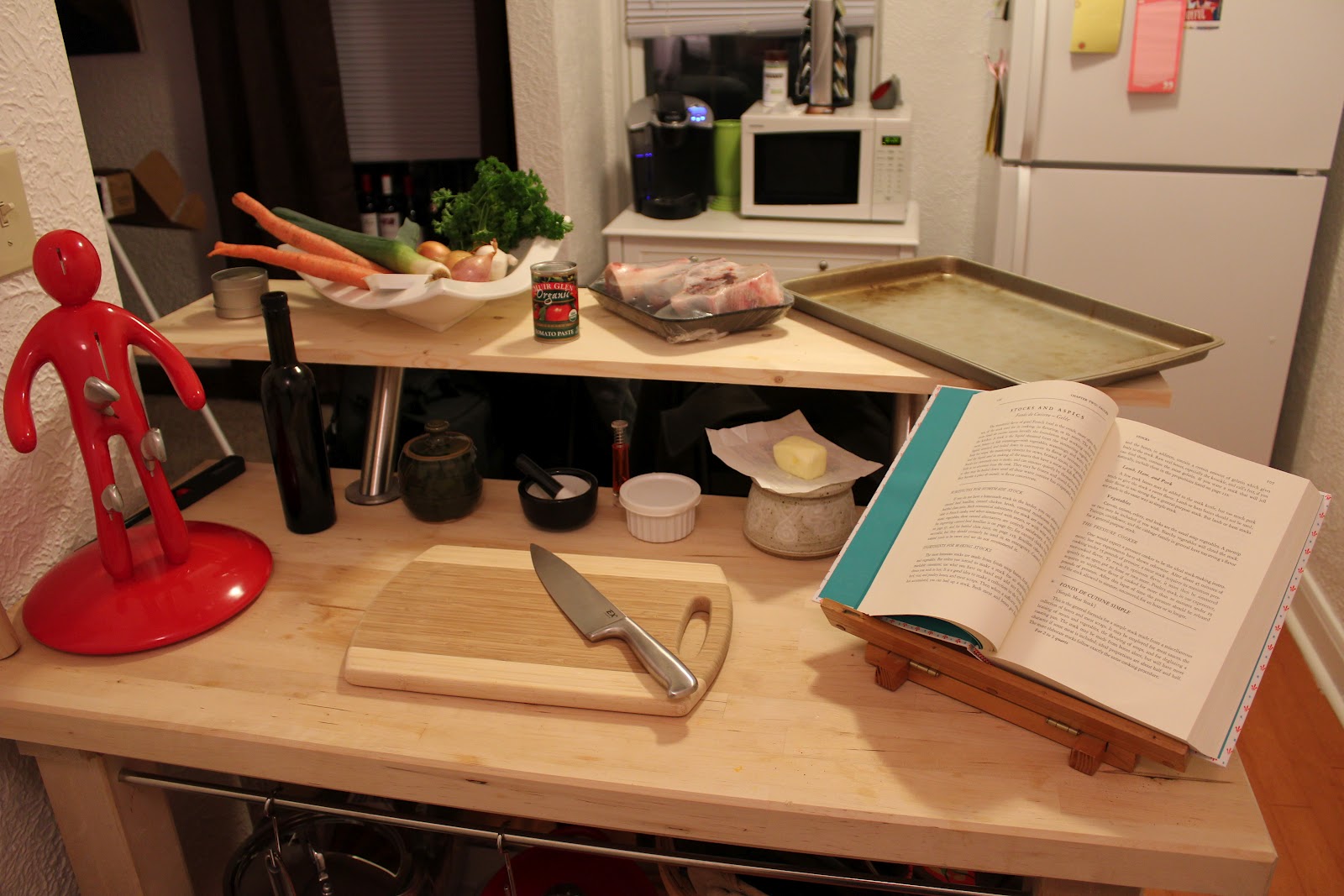
Next was the prep: Roasting the bones.
Then Came the simmering and skimming of the scum


Then the aromatics:


Then, nearly 10 hours later... The finished product:


It truly has been a labor of love, but every dish I've made thus far has been a complete change. Trust me when I say that it was long, tedious, at times required more focus than I could give, but it has made a significant impact on the way I view food preparation. It is recommended that you use up your stock within 2-3 days of making it. One taste, and I guarantee it won't even last that long. Hello Wisconsin!

Friday, September 3, 2010

Plaisirs Simples

Lately, French cooking seems to be on a huge upswing in popularity. This is a trend that seems to periodically crop up from time to time in American food culture. This time around the popularity is likely attributed to pop culture, specifically movies like Julie and Julia. Although, I believe the reason it keeps making it's comeback is because, as a general rule, French cooking is steadfastly rooted in classic methods that are cornerstone to cooking.

Now, when someone mentions French cooking, one almost invariably thinks of complicated soufflés or odd main ingredients (escargot, anyone?). But as with any style of cooking, these are extreme elements of the style, and should not discourage you from making the easier, more mainstream stuff.

These little chocolate truffles are such a great example of one such dish. Simple to prepare, but as I found out, one that can still present it's own unique challenges. This was definitely the case this time around, because I know that chocolate can be a wildcard ingredient.

So undaunted, I set about making my homage to Julia Child's chocolate truffles.

It's not often that I will suck up my pride and write about mistakes that I make cooking, so this is a very special blog entry. Turns out that even though I preach about using the best ingredients when making food, sometimes I fail to heed my own advice. In this case, using run-of-the-mill chocolate yielded a result that was overly bitter and had an oddly soured taste. I guess this is why I always say to treat your cooking as an experiment, and learn from the results that are yielded by the various things you try. In this case, always the best chocolate for chocolate candies.

The recipe is based on the recipe from the 2nd volume of Mastering the Art of French Cooking by Julia Child and Simone Beck. However, since I had just acquired a bottle of Port wine, I decided to substitute this in place of the orange liqueur. Keep in mind the following recipe is the one where I've corrected my mistakes, so you'll also see that I've omitted the coffee as well.

Start by preparing for melting the chocolate. You'll need two saucepans; one smaller than the other so that it can fit into the larger pan. If possible use a pan with an unclad (thin) bottom.
Fill the larger pan 1/4 full with water and bring to a simmer over med-low heat.

Next prepare the chocolate.
You'll need
1/3c Chambord
1T honey
9oz semisweet chocolate broken into small pieces.
In the smaller saucepan stir the chambord and honey together and simmer over medium heat. Allow to reduce to 1/4c. Stir chocolate into the reduction and remove from heat. Cover and place into larger saucepan and allow a few minutes for the chocolate to soften.

Now prepare the ganache:
You'll need:
1/4c + 2T chilled Unsalted butter cut into about 20 thin squares.
1/4c port wine with 1t honey stirred in.
Remove the smaller pan from the larger and using a whisk or an electric mixer beat until smooth and all the chocolate is melted. Next add butter 1 slice at a time and beat rapidly adding the next slice just before the previous one is melted. Once all the butter is incorporated, beat in the port wine mixture a couple of drops at a time.

Next chill the ganache for about 1 1/2 - 2 hours until firm.

Last form the truffles and enrobe in cocoa powder.
You'll need:
1/3c cocoa powder
2T confectioners sugar
2t kosher salt ground into a fine powder in a mortar.
In a small bowl, mix the cocoa, confectioners sugar, and salt. When the mixture has become thoroughly firm, use a melon baller to scoop small balls out of the pan and enrobe in the cocoa mixture. Place each ball into a small muffin cup.
Place and keep in the fridge or freezer in an airtight container.

Again, play with the ingredients, but mostly, make sure you have someone to pass them off on, or you'll eat them all yourself. (unless they turn out like my first batch)

Posted from Brett's iPhone